
 1/1
1/1
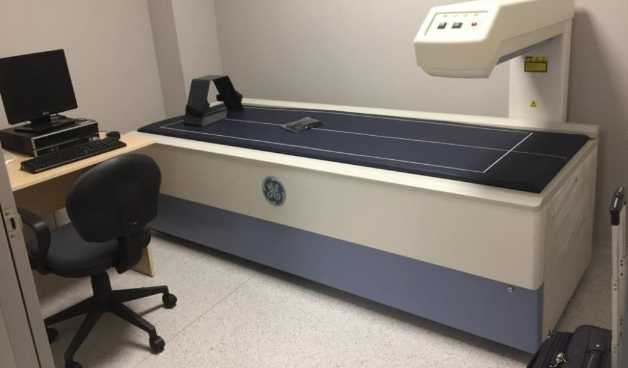
GE Lunar DPX PRO
RUSSIA and Central Asia
PRODIGY is the first digital densitometer for bone mineral density (BMD),
fracture risk assessment (FRA), and body composition assessment using a
cadmium zinc telluride (CZT) detector array and narrow-angle fan beam technology,
providing :
Minimizing distortion to produce a seamless, high-quality image;
Fast receipt of scanograms (from 10 seconds);
Ultra-low dose radiation;
Unrivaled clinical accuracy with T- and Z-score calculation.
EVALUATION CAPABILITIES AND CLINICAL INNOVATIONS
Dual-energy lateral and frontal spine imaging with morphometric analysis (DVA) .
This test allows for a more accurate assessment of bone mineral density and
the risk of vertebral fractures. A previous fracture at least doubles the risk of
future fractures, regardless of bone mineral density.
The main advantages of the program:
Visual assessment of the entire spinal column;
Morphometric assessment with the possibility of simple, step-by-step quantification;
Availability of a database for comparing the height of vertebrae and
the ratio of their sizes;
Subtraction of artifacts caused by soft tissue overlays to obtain a better image of
bone structures;
Determination of bone mineral density in the lumbar spine.
Proximal femur examination: bone mineral density assessment in one femoral neck
(Femur), two femoral necks (Dual Femur), comparative analysis,
advanced femoral neck assessment (AHA), its length, strength, elasticity,
and diameter with color mapping of mineral density and cortical thickness.
Both the left and right proximal femurs are assessed quickly and without
patient repositioning. Results are automatically combined in a single,
easy-to-interpret report.
Total Body with Body Composition Analysis. The Total Body program provides an
initial assessment of the patient's skeletal system. It includes a zone-specific analysis
assessing not only bone mineral density but also fat, muscle, and connective tissue,
providing information on body composition.
The main advantages of this program are:
The study takes no more than 5 minutes;
Ease of patient positioning;
Ultra-low dose radiation;
Availability of the WHO reference base for studying body mass index (BMI);
Possibility of comparative assessment of western (android/gynoid) adipose tissue.
The results obtained are used in:
Endocrinology (diagnosis of secondary osteoporosis, in case of unclear results of
bone mineral density assessment, assessment of the type of distribution of
adipose tissue in various endocrinological diseases, etc.);
Sports medicine;
Dietetics;
In the treatment of eating disorders;
In assessing the risk of cardiovascular diseases, etc.
Examination of the bones of the forearm and hand.
Pediatric programs allow for bone mineral density testing of the spine and femoral neck,
as well as whole-body compositional analysis in children aged 5 to 17 years, as well as in
infants aged 0 to 5 years. This program is also used to compare a patient's actual
(chronological) age with their so-called "bone age."
Orthopedic program with the ability to dynamically assess the stability of
the installed prosthesis in 19 assessment regions.
Full-size fixed patient table with positioning features and a washable surface,
maximum patient weight 204 kg.
SOFTWARE FOR WORKING WITH THE SYSTEM
A program for quickly scanning individual skeletal regions (spine, femoral neck)
(Quick View). Scanning time from 10 seconds.
A program for simultaneous scanning of multiple skeletal regions (One Scan)
allows the spine and both femoral necks to be scanned sequentially in
a single procedure, without repositioning the patient.
The results are automatically combined into a single clinical report.
A program for printing multiple images on one sheet (One Vision) to
create a single clinical report.
Specialized programs for generating reports , working with databases,
and conducting automatic comparative analysis (Composer).
International DICOM format and HL7 compatibility.
This program integrates densitometry results with the clinic's
Radiological Information Systems (RIS) and Image Archiving and
Information Processing Systems (IAIPS). Digital densitometry results can
be displayed in another system operating in the international DICOM format and
located at a significant distance from the examination site.
Teledensitometry allows data to be sent via fax or email and accessed on
any personal computer. This allows for digital reports to be received for
review or review by physicians via email or fax. The digital report is created as
an attachment to a standard email. The report can be displayed on any PC without
the need for specialized software. The digital report contains all the
information found on a standard hard drive: patient information,
high-resolution images, a comparison curve with control data, a clinical results table,
and trend graphs for monitoring changes over time.
A guided program for eliminating errors during online spine and femoral
neck examinations (CAD) will advise the operator on how best to work with
the image to obtain optimal results.
Specialized programs for working online for 3 or more users.
ADDITIONAL SYSTEM CAPABILITIES AND SCIENTIFIC ACHIEVEMENTS
A program for removing metal objects from an image area to exclude them
from the calculation of results.
The enCORE™ GE Lunar software on Windows XP Professional provides:
Fast data entry;
Opening multiple scans;
Control in software menu mode;
Network interaction, data transfer capability.
The PRODIGY SmartSCAN algorithm allows for the localization and tracking of
bone anatomical structures in real time to avoid re-scanning and
reduce scan time and dose.
PRODIGY is also the first fan beam system to utilize MVIR (Multi-Variable Image
Reconstruction) for accurate bone mineral content (BMC) quantification and
soft tissue analysis.
Optimal performance, single-step automated analysis. PRODIGY's
fully automated analysis allows for immediate patient test results,
processing, and conclusions.
Brief, concise reports.
The reports are easy to interpret, clearly presenting patient information,
the scanned image, and a fracture risk assessment based on World Health Organization
(WHO) criteria. Trend analysis and graphs also help physicians monitor changes in
bone mineral density over time.
Trend analysis.
This program automatically combines all patient scans into a single,
accurate clinical report, generated during the clinic visit.
Trend analysis records the time of the scan and provides a consistent,
dynamic analysis of changes in the patient's bone mineral density in a graph.
Protection from obsolescence.
Rapid technological advances require that medical equipment be protected from
obsolescence. The PRODIGY series of densitometers offer numerous capabilities
and can be upgraded as new clinical programs are released and
the technical specifications of the devices in this series are refined.